
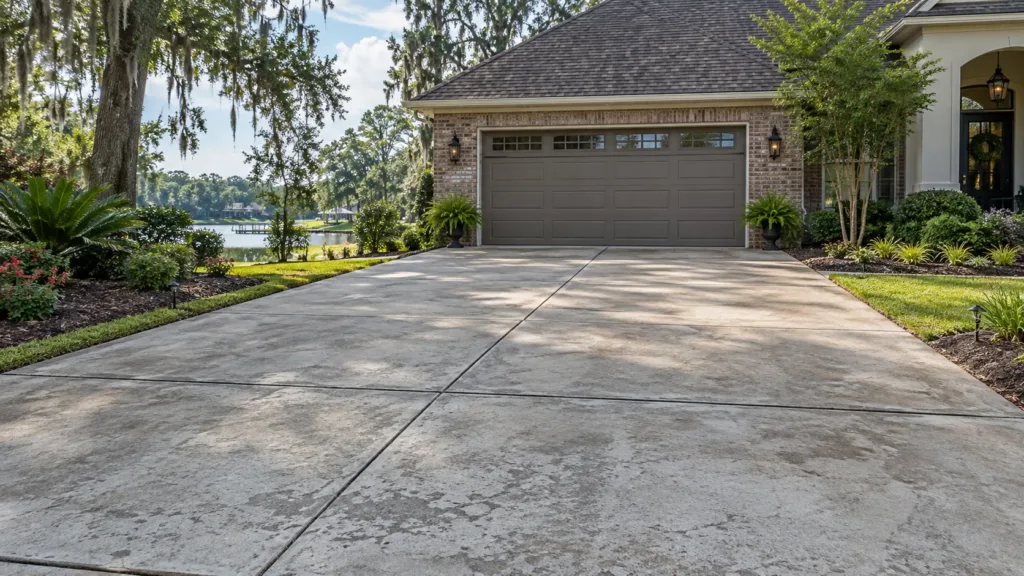
A practical guide for planning how to photograph your driveway for a cleaning estimate. Start with the visible condition, define the surfaces and request a scope that fits your property.
Start with the condition you can actually see
One wide photograph should show the driveway from the street to the garage, including expansion joints and bordering beds. Add separate close-ups of oil marks or discolored patches rather than sending only tight stain photos.
Define the work before choosing a date
Mention whether cars can be moved and whether the driveway is shared. Identify coatings, repairs and recently poured sections; they may change the recommended approach.
Make the decision for your property
Label driveway photos by location: street end, garage end, left edge and right edge. Include a familiar fixed feature so the contractor can connect close-ups to the wide view. If the property has a side parking pad, say whether it belongs in the scope. A photograph taken while cars cover half the slab can hide both the area and its condition. Rather than guessing a square-foot price from that view, provide the missing photos or discuss a site assessment. Keep addresses and property details in the estimate request; they do not need to appear in a public review or social post.
Explore the service and confirm your location
Read about pressure washing, check the service-area directory, or start an online quote. Include your address so availability can be confirmed for the specific property.
Your project checklist
Take the first driveway photo from a safe position near the street with the garage and both pavement edges visible. Take the second from the garage facing outward. Add separate close-ups of oil, rust, cracks and coatings, and label each by its position in the wide view. Include side parking and the street apron only if you want them assessed. Move vehicles when practical before taking photos; a covered portion of slab cannot reliably be assessed by extending the appearance of the visible section.
Identify the slab before choosing a treatment
A concrete-looking surface may be ordinary poured concrete, exposed aggregate, a cement coating, pavers or a decorative overlay. Photograph an edge, an expansion joint and any change in texture. Mention recent pours, repairs, sealers and coatings. A cleaner needs to distinguish embedded staining from a finish that is already wearing away. The condition of the surface layer limits what pressure and chemistry can safely accomplish; a harder-looking material is not permission to use the highest setting.
Separate organic buildup from oil and rust
Mark algae, oily spots and orange staining as different problems in your request. Organic buildup can spread over damp shaded sections, while petroleum can penetrate the slab and rust can react with the surface. One general wash does not necessarily treat all three. Ask which specialty treatments are included, whether a test area is appropriate and which shadows may remain. If a vehicle, irrigation component or metal item is still leaking or staining, correcting that source helps protect the cleaning result.
Measure connected areas separately
List the driveway, street apron, side parking pad, entrance path, steps and patio as separate areas, even when they connect. A wide photograph should show where each section begins and ends. Note whether cleaning stops at an expansion joint, a property boundary or a change in material. This avoids accidentally including a neighbor's shared access or excluding the small path that visitors actually use. If measurements are approximate, label them as estimates rather than presenting them as a verified takeoff.
Plan a usable route around the work
Moving vehicles after hoses are laid out can interrupt cleaning and track dirty water back across finished sections. Agree on a parking location and keep a separate walking route available where possible. Identify garage thresholds, doorways, low points and drains before work starts. Wet pavement still needs care even after the buildup is removed. Ask when the area can be used again for the actual treatment proposed; cleaning, specialty stain treatment and any later coating may have different access requirements.
Account for coatings and decorative finishes
A clear sealer can be difficult to identify from a distant photograph. Tell CoKo's about any known coating, stain, stamped finish or earlier resurfacing. Include peeling edges, cloudy patches and areas where a tire or furniture has worn the finish. Cleaning should not be confused with stripping or restoring a coating. If sealing is planned afterward, the coating provider should specify the required preparation and drying conditions. Confirm that responsibility before booking separate contractors on consecutive days.
Inspect edges as well as the middle
Photograph the pavement next to grass, planting beds, brickwork and painted trim. Soil can wash back from a raised bed, irrigation can leave repeating marks, and mulch can complicate cleanup. A route that looks straightforward from the street may have a narrow access gate or a fragile drain cover at the far end. Those details affect equipment placement and containment. Show the whole job in context rather than asking someone to estimate labor from one close-up of the cleanest section.
Compare results after the surface dries
Wet concrete often looks darker and can temporarily disguise stain shadows or differences in finish. When reviewing the work, compare the same area after it dries and use the same camera angle and similar lighting as the original photograph. Distinguish residual staining from unremoved loose material. An old repair, permanent etching or aggregate variation can remain visible after a careful cleaning. Ask for an explanation before assuming that another stronger pass would improve the result without creating damage.
Build maintenance around the returning source
A shaded entrance that stays damp, a leaking vehicle space and an open sunny driveway do not necessarily need the same maintenance interval. Keep a few dated photographs showing where buildup returns first. Clearing leaf accumulation, correcting runoff problems and dealing with recurring leaks can be more useful than automatically washing the entire property more often. For the next estimate, send those observations along with the new photos so maintenance can target the actual problem areas rather than repeating a generic schedule.
Questions about this project
Send your address. Show us what needs cleaning.
Text your address, a wide photo and a close-up of the buildup. We’ll review the surfaces and discuss your cleaning options.
Text photos for an estimate Start an online quoteCoKo’s Pressure Washing · (504) 296-9696