
Commercial exteriors · Greater New Orleans
Natural stone.
Know the finish.
Organize a commercial stone entrance or plaza washing request with stone identity, finish records, joint condition, trial-area questions and entrance planning.
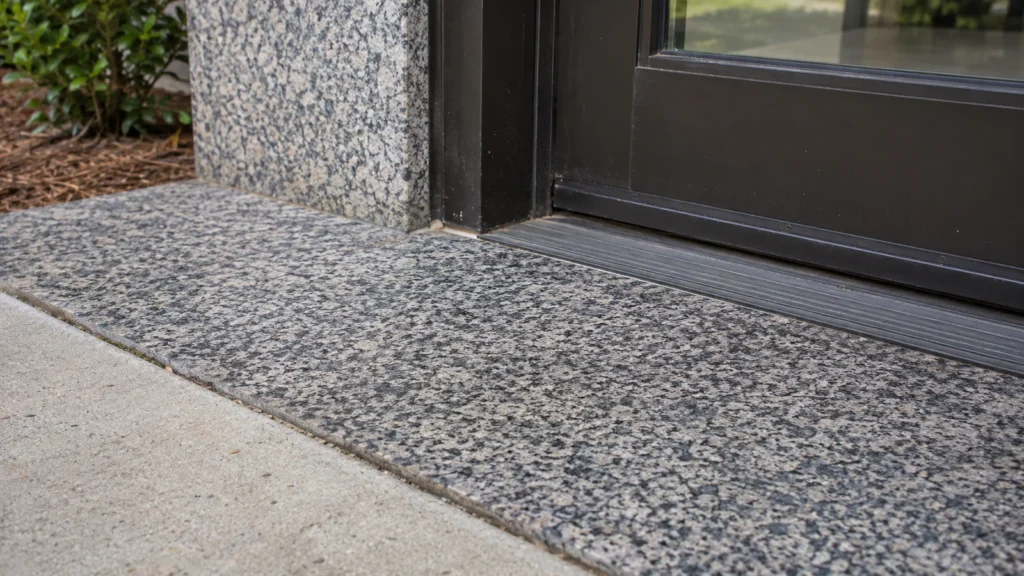
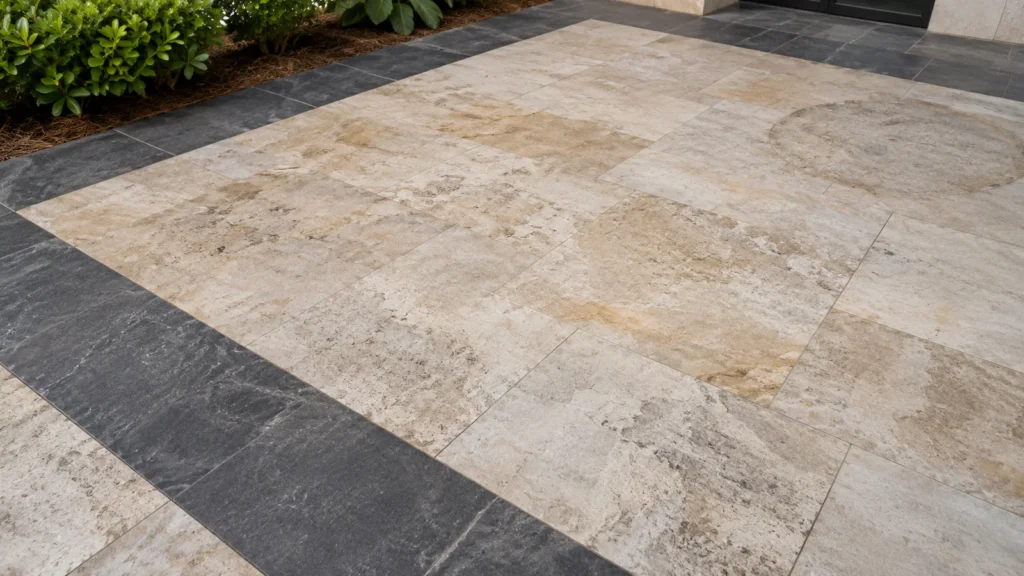
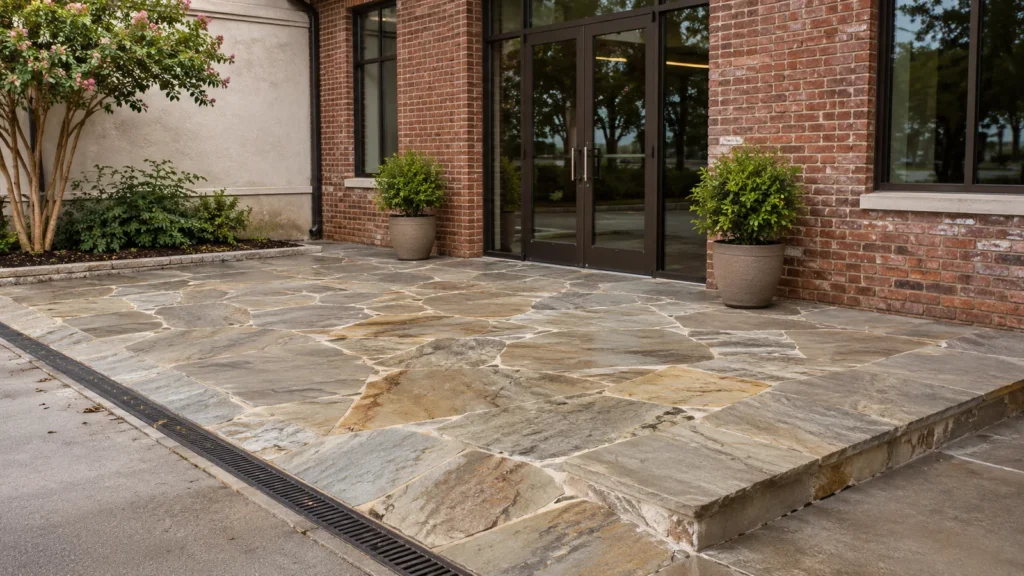
Generated property illustrations; not named properties or completed CoKo’s jobs.
Your property. Your priorities. A clearly defined scope.
Identify the stone before defining the wash
A commercial entrance may combine natural stone, manufactured tile, concrete and metal within a few steps. When the request concerns a natural-stone landing or plaza, identify that surface before selecting a washing method. A stone-looking pattern does not establish the material, and a glossy appearance does not identify the finish or a protective treatment. Start with the property records, installer information and the specific area you want considered.
CoKo’s can review a defined exterior-washing request for a Greater New Orleans property. This guide helps organize natural-stone surface information and commercial access. It does not advertise stone restoration, honing, polishing, crack repair or conservation work. For individual paving units of uncertain material, the commercial paver guide remains a useful starting point; the stone identity and finish determine whether this more specific review applies.
Gather the supplier’s description
Look for the installed stone name, supplier, finish description and available maintenance sheet. If the building has several renovation phases, check whether the entrance border and central field came from the same installation. An invoice calling one area limestone and another granite is useful information even when the colors look similar. If the records cannot be found, identify the material as unknown rather than choosing a familiar stone name.
The Natural Stone Institute explains that stone composition affects cleaning-product selection and that acidic products can harm calcium-carbonate-based stone. That is a reason to obtain the actual material guidance, not to prescribe a product from a photograph. Share relevant supplier instructions with the request. Avoid testing household chemicals on the entrance simply to see whether a mark responds.
Separate stone, finish and applied treatments
The stone name is only part of the description. Supply any records naming a polished, honed or textured finish and any sealer or other applied treatment. Photograph a normal traffic lane and a sheltered area so the existing appearance can be discussed. Do not assume that a shinier patch is cleaner or that a dull patch contains removable soil.
Explain any known coating application, previous stripping attempt or change after an earlier cleaning. The request should distinguish maintenance washing from changing the finish. CoKo’s should not promise to restore reflectivity, remove etching or renew an unidentified treatment through ordinary washing. If the primary concern is lost polish or surface damage, specialist assessment may be needed before a cleaning scope can be sensibly agreed.
Mark the usable area and its borders
Show the landing or plaza in one wide photograph with the building entrance visible. Then mark the requested stone field, border, steps and any vertical risers separately. Identify neighboring concrete, tile, brick, metal thresholds and planted beds. A floor-area estimate alone can miss the edge details that matter to the request.
If several tenants share the entrance, identify the party authorized to approve the work and arrange access. A tenant’s interest in a cleaner doorway does not establish control over a shared plaza. Keep private property, a public sidewalk and neighboring parcels distinct in the marked scope. This avoids treating a small entrance request as permission to wash every visually connected surface in the frontage.
Describe marks without promising their removal
Point out the location of leaf marks, beverage spills, planter rings, rust-colored spots or dark traffic paths. Explain what is known about the source and previous treatment. A close view should be accompanied by a wider reference so the estimator can find the concern. Record whether the mark is recent, recurring or present since the current manager took responsibility for the property.
Appearance alone does not establish whether a mark is surface soil, a deposit, a finish change or damage within the stone. Ordinary washing may leave some marks visible. Do not ask for a stronger process solely to make every patch disappear. A useful proposal separates general washing from any specialty stain work that would need additional identification, testing or a different qualified provider.
Give joints, edges and loose areas separate attention
Show the existing joints and point out missing material, movement, raised edges or damaged stone from a safe walking position. Do not lift a piece, scrape a joint or tap repeatedly on the installation to produce a diagnosis for a quote. Tell the manager about the observed condition and include any available repair report.
Washing does not reset stone, repair joints, correct uneven paving or verify the condition of the installation beneath the surface. If a damaged area needs review first, mark it as a hold rather than asking the cleaner to work through it. The maintenance plan can then distinguish an agreed sound area from surfaces awaiting the appropriate repair assessment. The existence of a cleaning request should not conceal a more important condition concern.
Agree on a representative trial area
Ask how the proposed approach will be reviewed on a representative, agreed portion before broader work proceeds. The location should reflect the actual stone, finish and soiling involved. A hidden corner that has never received traffic may not answer the same question as the entrance field. Different materials or treatments may need separate review rather than one assumed result for the whole plaza.
Record what the trial is intended to establish and who can approve the next step. Look at the existing condition and the appearance after the agreed review period, including when the surface is no longer wet. A trial does not create a guarantee that every stain will disappear. It gives the owner and provider a practical opportunity to identify an unsuitable approach or an unrealistic appearance expectation.
Have the property photos?
Let’s define the next step.
Send the address, requested surfaces and the contact who can confirm access.
Keep cleaning separate from slip-performance claims
A manager may be concerned about a dirty-looking walking route, an existing slippery area or both. Explain those concerns separately. Record where the problem occurs and whether it relates to rain, a spill or a particular section. Do not assume that an appearance wash supplies a slip rating, safety inspection or confirmation that the installed stone is appropriate for its use.
Return-to-use arrangements need agreement for the actual project. Washing is not a guarantee of a slip-free entrance in all weather. Mats, signage, accessibility, surface selection and building operations may involve other responsible parties. If the owner needs formal testing or a safety determination, that requirement should be identified independently rather than being implied by a cleaner-looking surface.
Arrange an entrance plan with the manager
Describe customer peaks, deliveries, staff arrival and any route that serves as the only entrance or accessible approach. The authorized manager should explain which sections can be released and how an alternative route would be communicated. A plaza that looks large in a photograph may still have a single narrow point everyone must use.
Discuss practical work zones against that layout. Whether phasing is feasible depends on the requested surfaces and operating arrangements; it is not an automatic service promise. Include movable displays, restaurant tables, queue barriers and entry mats in the preparation discussion. Establish who will move and replace them. Cleaning the stone floor does not automatically include cleaning every object normally placed on it.
Review rinse water and neighboring finishes
Photograph drainage points, low spots, metal fixtures, glazed doors and planted edges beside the requested stone. Tell the estimator about known pooling and any written site restrictions. Identify who can authorize water access. Do not treat a doorway threshold or nearby drain as a convenient destination for wash water without a site-specific review.
The selected approach must account for the actual surrounding materials and wash-water arrangements. A product intended for one surface should not be assumed appropriate for an adjoining finish. The owner should share supplier instructions for sensitive components where available. If the proposed work cannot be reasonably separated from an unresolved neighboring condition, keep that issue visible before scheduling rather than relying on a general promise to protect everything.
Compare proposals using the actual stone scope
Give each provider the same marked area, material records, existing-condition photographs and business access window. Ask that the proposal identify the included surfaces, any trial area, exclusions and the person responsible for preparation. General washing, specialist stain treatment, polishing and sealer work should not be bundled by assumption under one vague phrase such as stone cleaning.
Keep a copy of the agreed appearance limitations. Review the completed work against the approved scope and documented starting conditions. A change in light or a wet surface can make photographs difficult to compare, so use recognizable locations and similar viewpoints. Good records support the next maintenance decision without claiming that a photograph proves the material’s condition or performance.
Request an exterior-stone review
For a property in Metairie, Kenner, LaPlace, New Orleans or another reviewed service area, send the address and identify the authorized decision-maker. Include the stone name if known, its finish, the marked entrance or plaza, the concern prompting the request and the hours when the area could be made available. Unknown information can remain clearly labeled while the request is reviewed.
Use cokospressurewashing.com/quote for a free online quote request or text the scope photographs to 504.296.9696. The aim is a practical decision about the actual exterior surface. If the request turns out to involve manufactured tile, decorative concrete or restoration needs, that should lead to the appropriate scope discussion rather than a promise to apply the same method to every material.
Material references: www.naturalstoneinstitute.org. References are not endorsements or service credentials.
A practical start.
Three useful steps.
Show the surfaces
Send wide photos and close views. Label the buildings and the areas that matter now.
Set the boundaries
Explain materials, access, preparation and the work window your property can support.
Review the scope
Confirm included surfaces, responsibilities and the next step before scheduling.
Commercial Natural-Stone Entrance and Plaza Washing Planning.
Your questions, answered.
Your next exterior project.
Start with a clearer scope.
Text your address and the priority exterior photos. For a larger project, send the full property details.
Send your address. Show us what needs cleaning.
Text your address, a wide photo and a close-up of the buildup. We’ll review the surfaces and discuss your cleaning options.
Text photos for an estimate Start an online quoteCoKo’s Pressure Washing · (504) 296-9696