
Commercial exteriors · Greater New Orleans
Pedestrian access ramp washing.
The slope. The landings. A workable access plan.
Text the ramp photos, surface details and entrance schedule. Let’s review a practical access plan.
Your property. Your priorities. A clearly defined scope.
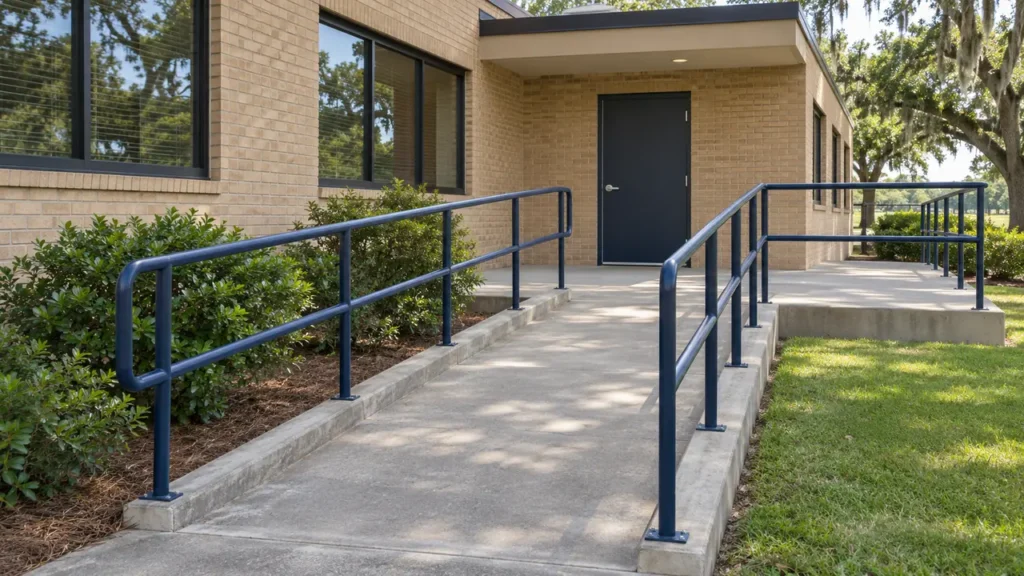
Define the ramp, landings and connecting pavement
A pedestrian ramp is often the route that a customer, resident or employee depends on to enter a building. Cleaning it involves more than drawing a rectangle around a patch of concrete. The slope, landings, handrails, entrance threshold and available alternative route all affect how a washing request should be planned. A short ramp can have more access constraints than a much larger open sidewalk.
CoKo’s reviews commercial pedestrian access-ramp washing in Greater New Orleans and the Westbank. Send a complete view from the bottom, another from the entrance and close photographs of the surface condition. Tell us who uses the ramp and whether it is the building’s only practical approach. The request can then be assessed around the actual materials and operating needs, without promising repairs, accessibility certification or an automatic result for every surface.
Start by drawing the requested boundary on a photograph. The sloping run may be only one part of the route. A level area outside the door, an intermediate turning platform and the bottom landing can each collect different residue. Include those areas by name rather than assuming that the word ramp covers everything between the parking lot and the lobby.
Show where the ramp connects to steps, sidewalks and another tenant’s entrance. Some properties have a shared approach even when each business controls its own door. Identify the person who can authorize work across that boundary. If the ramp belongs to the property owner while the entry mat belongs to a tenant, clarify those responsibilities before the estimate. The goal is a work area that can be described and checked without leaving an important transition undefined.
Identify concrete, coatings and manufactured assemblies
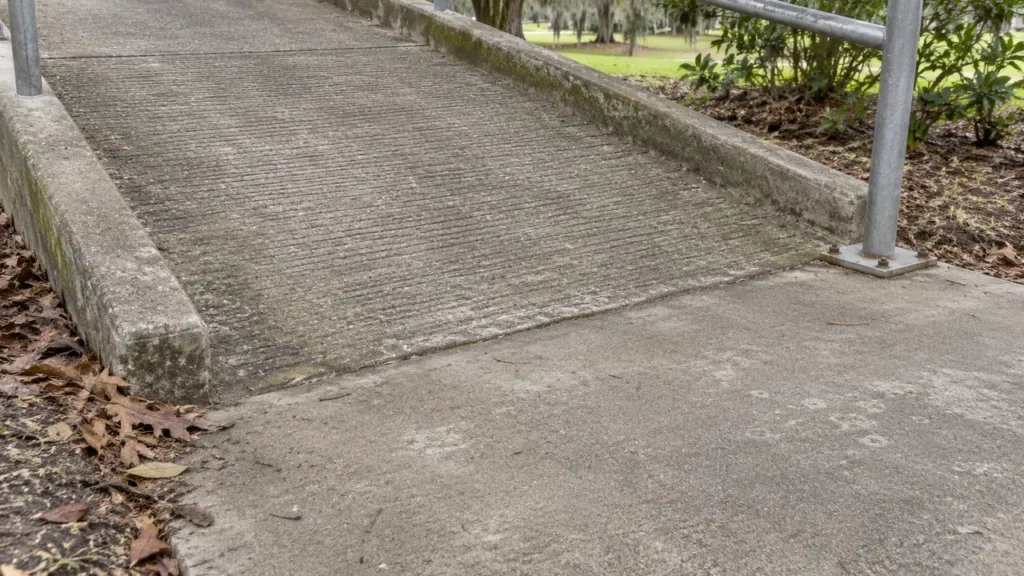
Broom-finished concrete, coated masonry, wood decking and modular metal ramps need different consideration. A photograph may show the apparent material without revealing a sealer, traction coating or recent repair. Provide available finish records and explain whether an installer has supplied cleaning instructions. A surface that looks durable may still have a vulnerable treatment on top of it.
EZ-ACCESS advises following manufacturer guidance when cleaning accessibility equipment and notes that pressure washing is not universally recommended. That caution is relevant to choosing a review process; it does not establish the method for a different manufacturer’s product. A prefabricated assembly should be identified before any washing proposal is accepted. We do not remove traction materials, alter the ramp or replace a coating as part of ordinary exterior cleaning. Uncertain materials may require information from the owner or installer before work can proceed.
If a ramp was recently sealed, repaired or repainted, give the completion date and any care information supplied with that work. Fresh-looking material is not permission to wash it immediately. The person responsible for the finish should resolve any timing restrictions before a cleaning date is requested.
Record the condition of the slope and transitions
Take close photographs of shaded areas, the bottom edge and any visible repairs. Leaf residue on a sound surface is different from loose coating, worn texture or broken concrete. Mark existing cracks, patched areas and places where water stands after rain. Photographs taken in comparable light help distinguish the deposited material from a darker section of the original finish.
Cleaning is not a correction for a damaged transition, an unstable rail or a slope that the facility is concerned about. Those issues need an appropriate separate assessment. We make no slip-rating or accessibility-compliance certification from a washing visit. If a surface defect is the main reason the route cannot be used as intended, discuss that before arranging appearance cleaning. Removing dirt should not be represented as solving an underlying construction or maintenance problem.
Plan a closure that works for the people using the entrance
Ask the facility contact how customers and employees actually enter. A side stair may be available to some people without being an appropriate substitute for everyone who uses the ramp. The property needs to establish a workable access arrangement before the route is temporarily closed. Do not assume that a verbal warning at the door will reach people arriving from the parking lot.
Discuss appointment times, tenant opening hours, deliveries and any residents who require ongoing access. If there is no suitable alternative route, the work may need a full closure window or another scheduling solution approved by the facility. The washing area and equipment approach should be kept separate from people entering the building. We do not promise uninterrupted use of the ramp while its surface is being washed. A practical closure is part of the scope, not an afterthought.
Treat handrails and adjacent entrance items separately
Handrails may be painted steel, aluminum, stainless material or another finish. Identify them independently from the ramp floor and disclose loose paint or known movement. A rail can be photographed and reviewed for suitable exterior washing without making its attachment or structural condition part of the cleaning service. Do not remove covers, loosen fittings or dismantle a rail to prepare estimate photos.
Entry buttons, intercoms, lights and automatic-door hardware also need to be shown. Explain which items must stay dry or need preparation by the property’s maintenance staff. Washing does not include electrical servicing or adjustment of entrance controls. If mats, portable signs or planters obstruct the route, agree who will move and replace them. The written request should make clear whether those items are excluded rather than quietly treating them as additional cleaning surfaces.
Have the property photos?
Let’s define the next step.
Send the address, requested surfaces and the contact who can confirm access.
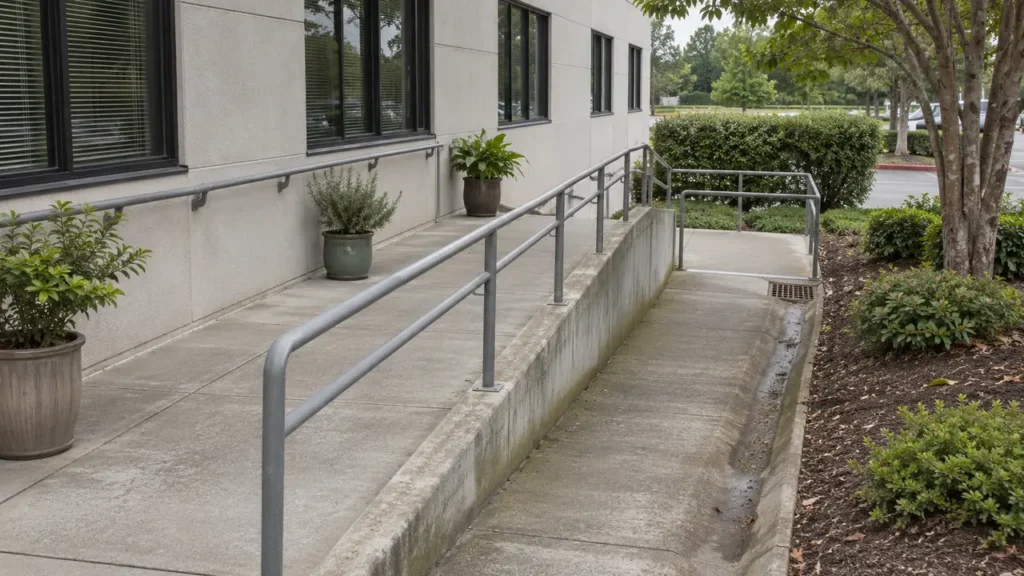
Follow the route water takes at the bottom landing
A ramp directs movement toward a landing, and its slope also affects where water travels. Photograph the low end, nearby drains and the connection to the public or shared sidewalk. Explain whether water already accumulates at a doorway or along an edge. The proposed washing work should not begin with an assumption that the ramp drains acceptably just because it has a visible slope.
The facility contact should identify the water supply and any property-specific restrictions on wash water. The pavement below the ramp and neighboring landscaped areas may need attention during planning even when they are outside the cleaning boundary. A nearby drain does not by itself establish permission to use it as an outlet. If the practical water route is unclear, resolve it before scheduling. No drainage repair, flood prevention or environmental approval is included in the washing estimate.
Compare a ramp quote by the usable work scope
Useful estimate information includes the requested run and landings, the material or coating, the rails and any connected pavement. Approximate dimensions can help if the property already has them, but a number alone does not describe the route. Include turns, restricted equipment access and the distance from the permitted setup location. Those details affect how a small-area job can actually be performed.
Ask which components are included, what preparation the facility must complete and what conditions could change the plan. A proposal for the concrete floor alone should not be compared with one that also lists rails, entrance pavement and several landings as if they were identical. The expected improvement should address the visible buildup rather than a guaranteed brand-new finish. Where deteriorated material or a special coating is involved, the estimate may need further review before approval.
Set a clear handover and a repeatable photo record
Arrange who will check the included areas when the washing portion is finished. Reopening depends on the agreed work conditions and the facility’s review, not a universal drying-time promise. Confirm that the normal entrance route is ready before notices or barriers are removed. Appearance cleaning does not transfer responsibility for inspecting the ramp’s structure or determining its suitability for users.
Keep the initial photographs with the written scope and take comparable views during the walkthrough. That gives the property a useful reference when deciding whether future attention is needed. A recurring request should reflect actual buildup and changes to the entrance rather than an unsupported fixed interval. Text CoKo’s the address, the complete ramp photographs and the person responsible for access. Related building walls or entrance sidewalks can be reviewed separately while the ramp work remains clearly defined.
A practical start.
Three useful steps.
Show the surfaces
Send wide photos and close views. Label the buildings and the areas that matter now.
Set the boundaries
Explain materials, access, preparation and the work window your property can support.
Review the scope
Confirm included surfaces, responsibilities and the next step before scheduling.
Commercial Pedestrian Access Ramp Washing.
Your questions, answered.
Your next exterior project.
Start with a clearer scope.
Text your address and the priority exterior photos. For a larger project, send the full property details.
Send your address. Show us what needs cleaning.
Text your address, a wide photo and a close-up of the buildup. We’ll review the surfaces and discuss your cleaning options.
Text photos for an estimate Start an online quoteCoKo’s Pressure Washing · (504) 296-9696