
Commercial exteriors · Greater New Orleans
Commercial curb washing.
The edges. The stops. A clearly marked scope.
Text the curb runs, stop counts and access photos. Let’s define the washing area.
Your property. Your priorities. A clearly defined scope.
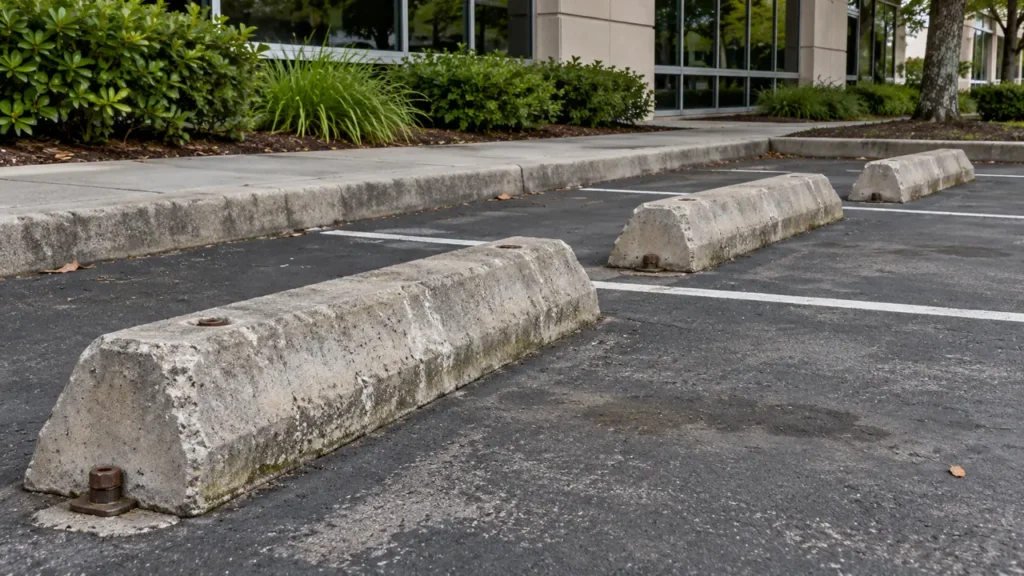
Mark the curb runs and individual parking stops
CoKo’s reviews commercial curb and wheel-stop washing requests in Greater New Orleans and the Westbank. These small surfaces deserve their own marked scope: the curb face beside a store, the top of a landscape island and a row of parking stops are different components from the broad pavement around them. Send photographs showing the exact edges and units you want considered.
This application concerns washing suitable existing exterior surfaces. It does not include moving or reinstalling stops, repairing concrete, renewing curb paint, striping a lot or certifying parking compliance. Begin with a clear count or marked site plan so the proposal can distinguish the requested details from an entire parking area.
A request for “the curbs” can mean several different areas on one property. Mark the street-facing frontage, the interior planting islands, the curb beside a pedestrian entrance and any loading-zone boundary separately. Show where each run begins and ends rather than relying on a distant photograph of the whole lot.
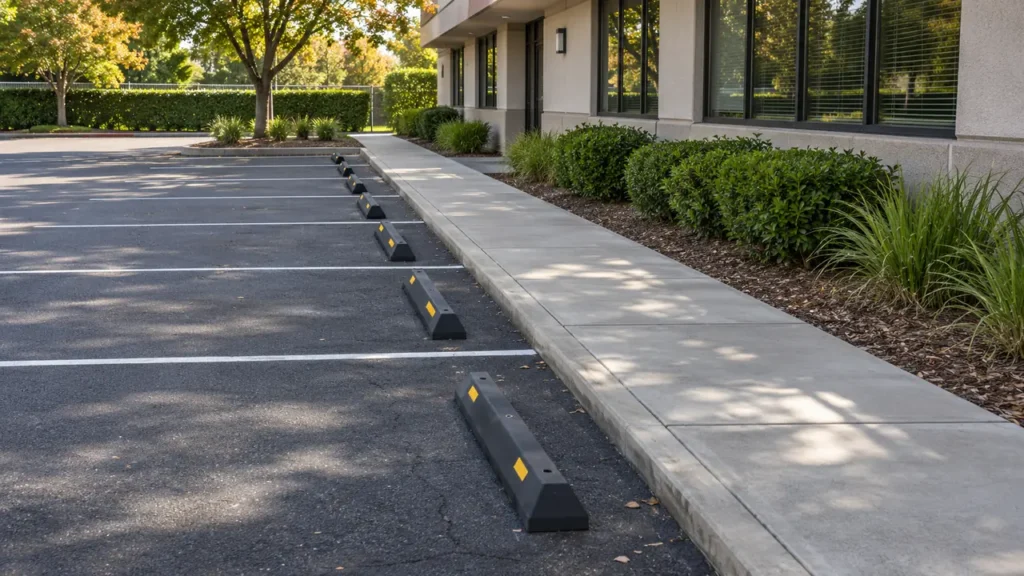
For wheel stops, identify the rows and approximate number of units. Explain whether the request concerns their exposed front faces, tops and ends or another agreed portion. A unit partly buried in soil or hidden behind parked vehicles may not present the same accessible washing area as an unobstructed stop.
Use the site’s ordinary row labels, nearby tenant names or a simple annotated photograph to locate the work. Those labels are for organizing access, not creating separate city or tenant service pages. If several tenants share the lot, identify the person authorized to approve the requested common-area work and settle any boundary questions before a date is agreed.
Identify the material before treating every stop alike
Wheel stops may be concrete, rubber, plastic or another manufactured product. Some have colored sections, reflective inserts or an existing painted finish. A uniform row can also contain replacement units of a different type. Photograph representative units and the exceptions, including any product information retained by the facility.
Appearance alone does not establish that the same washing method is suitable for every unit. Tell CoKo’s about known material restrictions, previous treatments and installed accessories. Where a manufacturer’s care instructions exist, provide them with the request rather than substituting an assumed setting based on another property.
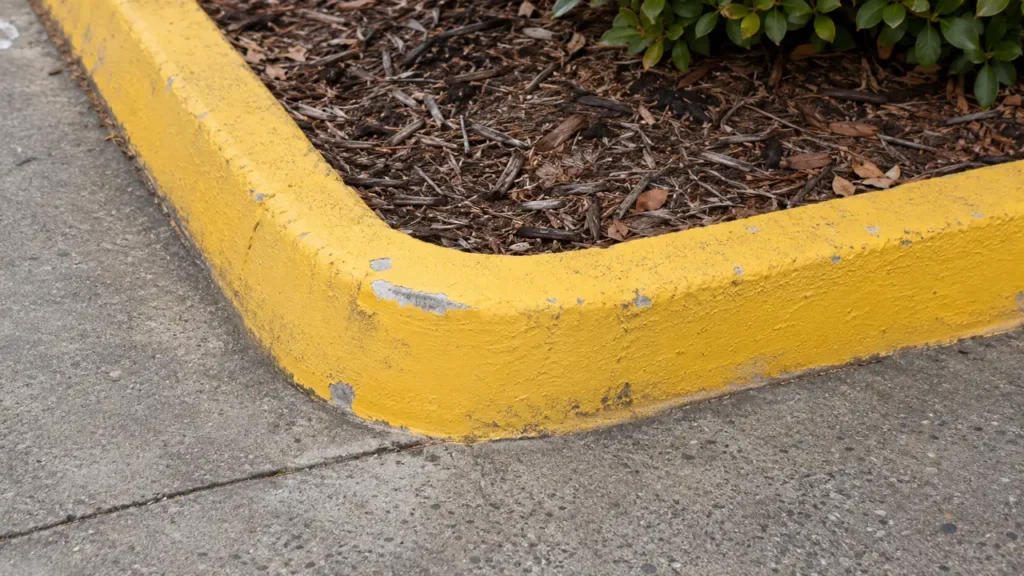
Concrete curbs can also vary along one lot. An older cast curb, a newer repaired section and a painted island edge should not be combined under a claim of identical condition. Identify the transitions so a proposed scope can make sensible distinctions without promising resurfacing or a new, perfectly matched appearance.
Separate the coating from the dirt around it
Painted curbs often carry information the property wants to retain. Photograph existing colors, numbers or markings and explain which finishes are intentional. The washing conversation should not assume that every pale patch is removable soil or that a faded painted edge can be restored through stronger cleaning.
Loose, flaking or already missing paint needs to be disclosed before service. Ordinary washing is not a repainting project and cannot recreate lettering, reflective details or a coating that has worn away. If paint renewal is planned, coordinate its preparation requirements with the provider responsible for that work.
Tire contact and vehicle scuffs also need realistic discussion. Show the marks at a useful scale and mention earlier attempts to remove them. The goal should distinguish removable buildup from abrasion, transferred material and permanent finish changes. No promise that every mark will disappear belongs in a general curb-washing request.
Record broken edges and loose units from a safe position
Curb corners and parking stops can receive repeated impacts. Show cracks, missing pieces, exposed anchors or a visibly displaced unit in the estimate photographs. Record the condition without standing in an active lane or asking someone to pull, lift or rock a heavy stop to demonstrate the problem.
Washing does not secure an anchor, reset a displaced block or correct the position of a parking stop. A damaged or unstable component may require exclusion until the owner or an appropriate repair provider addresses it. Keep that decision separate from a surface-cleaning quotation.
Also disclose fragile adjoining pavement, open joints and repairs beside an island. The work boundary includes more than the visible front face of a curb when water and equipment must move nearby. A close photograph can reveal a vulnerable transition that is absent from the overall parking-lot image. Updated photographs are useful if repairs occur after the initial inquiry.
Arrange empty stalls and a workable traffic boundary
Parked vehicles can hide the face and ends of a stop, restrict hose routes and prevent access to the curb behind a stall. Identify who can arrange a vacant row and communicate the proposed window to tenants or staff. Do not assume that a washing crew can move vehicles or enforce a parking restriction.
A busy retail frontage may need a different sequence from a staff-only row behind an office. Show the drive aisles, delivery approaches and pedestrian crossings that adjoin the requested units. The property contact should explain which movements must continue and where a temporary work boundary can realistically be maintained.
Count the usable work windows as part of the discussion, especially if the same row fills repeatedly throughout the day. A plan to clean one accessible section at a time can be reviewed without promising that all traffic can continue unchanged beside active washing. Access arrangements should be agreed before the crew arrives.
Have the property photos?
Let’s define the next step.
Send the address, requested surfaces and the contact who can confirm access.
Include the island and the surfaces beside the edge
A landscape island can contain planting, exposed soil, irrigation components, sign supports and other objects close to its curb. Photograph these details at ground level. Explain who will move movable items and which fixed components should remain outside the washing scope.
Soil or mulch covering part of the curb can conceal the surface and change the practical boundary. Landscape excavation, regrading and removing established planting are different tasks. If an edge must be exposed first, the owner should coordinate that preparation rather than assuming it is included in ordinary washing.
Identify curb ramps, adjacent walks and entrances that need to remain available. Cleaning a curb does not establish that a route meets an accessibility standard or correct a damaged transition. The proposed work should respect the property’s access plan while keeping washing, repairs, pavement markings and any compliance assessment as separate responsibilities.
Make the water route part of the site discussion
Photograph low areas, visible drain openings and the direction water ordinarily travels along the requested curb run. Include any recurring pooling or existing drainage concern. The curb-and-gutter shape can guide water toward another part of the property, so a photograph of the front face alone is not enough to explain the setting.
The authorized contact should identify an approved water connection and applicable facility procedures. A drain beside an island does not by itself establish an acceptable wash-water destination. Appropriate arrangements need to be reviewed for the actual materials, buildup and property restrictions before the scope is accepted.
Drain clearing, damaged-pipe repairs and specialized disposal should not be presumed included in a washing proposal. If debris already blocks an opening or the site has unresolved water-management concerns, explain that in the initial request. Those details can affect preparation and whether the proposed work area is suitable for the intended visit.
Compare the proposal by the actual components included
Send the address, marked curb runs, estimated stop count, material photographs and the authorized property contact. Include the condition concerns, parking arrangements and any planned painting or repair work. This makes it easier to review a focused detail-washing request instead of accidentally asking for an entire lot.
Check that the proposal identifies the accessible faces and units, exclusions, preparation responsibilities and reasonable appearance limits. If ordinary sidewalk or larger paved-area washing is also wanted, list it separately so the property can understand what each part contributes to the work.
Retain the marked plan and representative photographs for later requests. Future maintenance should respond to the same components’ actual condition and the property’s priorities, with no universal repeat interval or guarantee against new marks. Update the record when stops are replaced, curbs are repainted or traffic patterns change. A precise scope remains useful even when the requested cleaning area is relatively small.
A practical start.
Three useful steps.
Show the surfaces
Send wide photos and close views. Label the buildings and the areas that matter now.
Set the boundaries
Explain materials, access, preparation and the work window your property can support.
Review the scope
Confirm included surfaces, responsibilities and the next step before scheduling.
Commercial Curb and Wheel-Stop Washing.
Your questions, answered.
Your next exterior project.
Start with a clearer scope.
Text your address and the priority exterior photos. For a larger project, send the full property details.
Send your address. Show us what needs cleaning.
Text your address, a wide photo and a close-up of the buildup. We’ll review the surfaces and discuss your cleaning options.
Text photos for an estimate Start an online quoteCoKo’s Pressure Washing · (504) 296-9696